Swing-out doors fail differently than overhead doors. There is no spring or track to blame — the whole weight of each leaf hangs off three or four hinges screwed into a wood post, and over years that post moves. The…
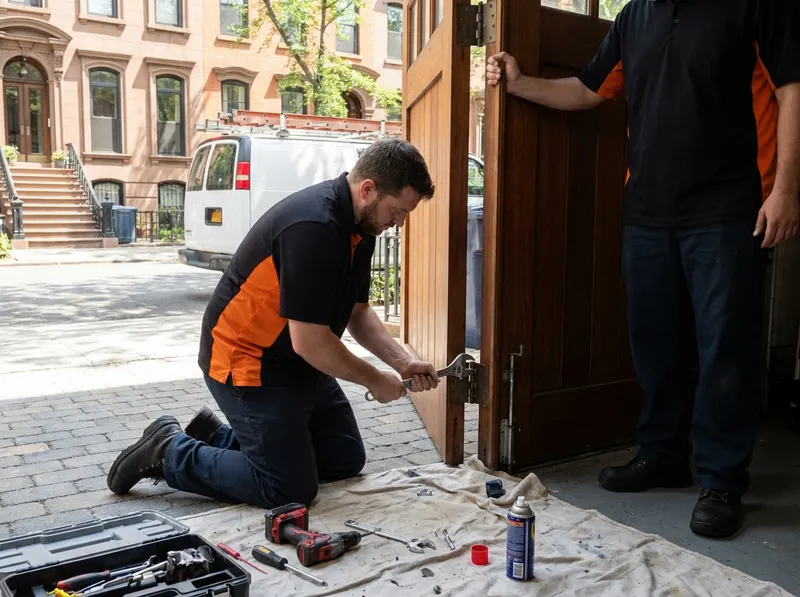
Swing-out doors fail differently than overhead doors. There is no spring or track to blame — the whole weight of each leaf hangs off three or four hinges screwed into a wood post, and over years that post moves. The tell is a door that scrapes the driveway on one corner, or a gap at the top where the two leaves meet, or a drop rod that no longer lines up with its hole in the slab. On the original wood doors still in service around Brooklyn Heights, Park Slope and parts of Bedford-Stuyvesant, we usually find the bottom rail soft with rot and the hinge screws stripped in wet wood. That is repairable when the stiles and frame are sound: new hardware, longer fasteners into solid material, a rebuilt or reinforced hinge post, and the door is square again. Replacement makes more sense when the frame itself is gone — a header rotted through or a masonry opening that has shifted — because new hinges on a failing opening will loosen again within a season.
The real Brooklyn question is whether a swing-out door still suits the spot it sits in. Side-hinged doors need three to four feet of clear ground outside to open, and they need it in winter too. In the shared driveways off the numbered streets in Sunset Park and Bay Ridge, and on the tight aprons behind Dyker Heights and Canarsie blocks, a neighbor's bumper or a snow ridge is enough to lock a swing-out door shut even though nothing is broken. Where clearance is chronically short, converting to an overhead sectional with a carriage-house face panel gets the same look and gives back the driveway. Where clearance is fine — most detached garages with their own curb cut — repairing the existing doors is the cheaper and less invasive path, and it keeps the original doors on a block where they match the neighbors. We say which one applies on site rather than defaulting to a sale.
Salt air matters on this door type more than most. Garages within a few blocks of the water in Sheepshead Bay, Marine Park and toward the Coney Island Boardwalk go through hinges, cane bolts and lock cylinders faster because the exposed hardware sits in damp air year-round. Corroded hinges are the most common single cause of swing-out door sag in South Brooklyn, and they are a straightforward parts-and-labor fix. Inland, in Greenpoint and Bushwick, the frequent job is different: old side-hinged shop and studio garage doors near the Brooklyn Navy Yard corridor that have been forced open for years, with split hinge stiles and latches that no longer secure the opening overnight. A door that won't latch is a security problem, and it gets treated as same-day work.
Access is not an obstacle. Narrow blocks, alternate-side parking, shared driveways and a garage you reach through a gangway are normal conditions here, and hand tools plus hardware cover most of this work — no lift or wide staging area needed. Automated swing-out doors get handled too: arm-style operators mounted on the jamb, their mounting brackets, and the limit adjustments that make both leaves close together instead of one before the other. Every quote is a ballpark until the door is inspected, because the hinge post condition behind the trim decides the labor. Call (929) 286-9970 with the symptom and the neighborhood.
Every job gets a firm, written price after a free on-site visit.
Tell us about your carriage and swing-out garage door repair job in Brooklyn and we'll send a clear, written quote — usually the same day.
 Canyon Garage Door's Repair Experts