Start with what the opener is telling you. A door that goes down a few inches and shoots back up is almost always a sensor or force problem, not a spring problem. A blinking LED on one photo eye means the beam is…
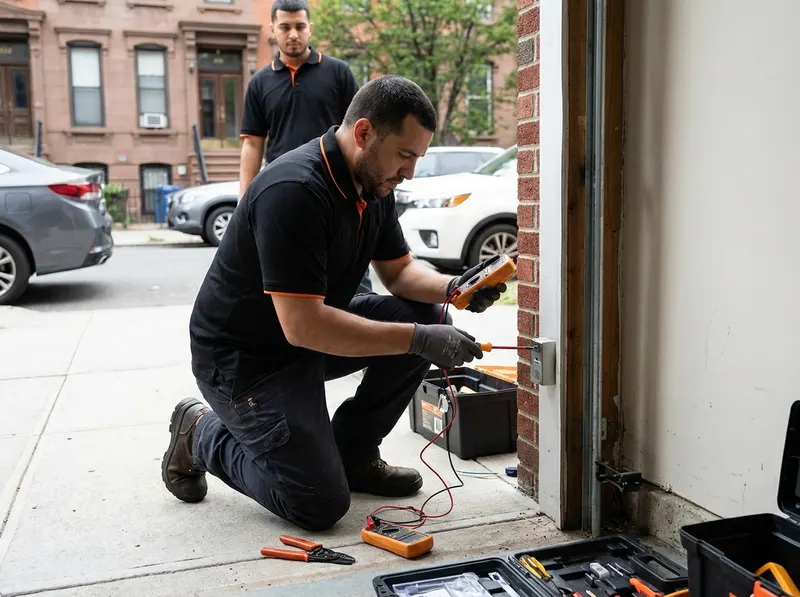
Start with what the opener is telling you. A door that goes down a few inches and shoots back up is almost always a sensor or force problem, not a spring problem. A blinking LED on one photo eye means the beam is broken or the eyes are out of line; a dead LED on the sending side usually means a wiring fault or a failed unit. A door that closes fine with the wall button held down but reverses on the remote points the same direction. We check the simple causes first — a bike wheel, a recycling bin, a bracket nudged by a car door in a shared Canarsie or Marine Park driveway — because those cost you a diagnostic, not a part.
Brooklyn puts specific stress on this hardware. Photo eyes sit about six inches off the slab, which is exactly where meltwater, plowed street snow and street grit end up, so we see corroded terminals and swollen wire splices on garages from Greenpoint down through Sunset Park. In Bay Ridge and Dyker Heights, salt air off the Narrows works on the sensor contacts and the staples holding the low-voltage run the same way it works on cables and hinges. On the flood-prone blocks near Sheepshead Bay, sensor housings that have been underwater once tend to fail intermittently for months afterward. West-facing driveways catch low winter sun late in the day and the glare alone can wash out the receiving eye — a hood or a slight re-aim solves it. Park Slope and Bed-Stuy carriage-style conversions often have the wire run stapled along a rough joist where a nail has pinched through the insulation, which reads as a random fault until someone traces the whole line.
Repair versus replace, plainly. If your opener is a working unit with photo eyes, sensor and auto-reverse issues are repair work nearly every time: realign, replace one or both eyes, re-run the low-voltage wire, clean or replace the bracket, then reset close force and the down limit. We do not lead with a new door or a new opener. Two situations genuinely call for replacement: a failed logic board on an opener old enough that the board costs more than a modern unit, and a pre-1993 opener with no photo-eye terminals at all, which cannot be retrofitted to current auto-reverse behavior. We will tell you which one you have and what each path costs.
One more thing worth checking on the same visit. If the door is out of balance or the rollers are binding, the opener sees extra resistance and reverses even with perfect sensors. Cranking up the force to "fix" that is the wrong move — it defeats the protection the auto-reverse exists to provide. We test the door's balance by hand with the opener disconnected, correct what is causing the drag, then set force at the lowest setting that closes the door reliably and still reverses on contact. For commercial roll-up gates on Bushwick and Sunset Park storefronts, the equivalent check is the safety edge and its cord — a very different part with the same job.
Every job gets a firm, written price after a free on-site visit.
Tell us about your garage door safety sensor and auto-reverse repair job in Brooklyn and we'll send a clear, written quote — usually the same day.
 Canyon Garage Door's Repair Experts