A tune-up is the right call when the door still moves but has started telling you it's tired: it groans on the way up, drifts down a few inches after you release it, sits crooked by an inch at the top, or the opener…
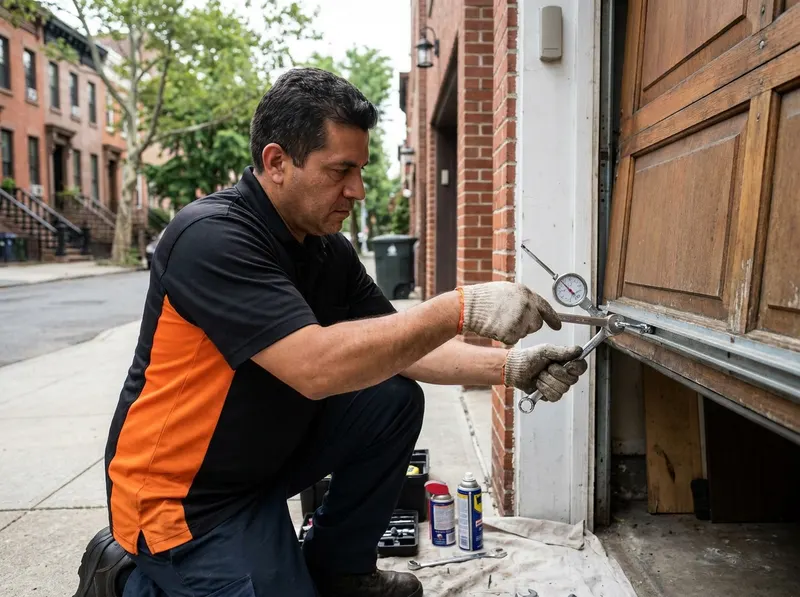
A tune-up is the right call when the door still moves but has started telling you it's tired: it groans on the way up, drifts down a few inches after you release it, sits crooked by an inch at the top, or the opener strains and hesitates before it commits. Those are tension and friction problems, not failures. The alternative — waiting — usually ends with a snapped spring or a frayed cable, and then you're calling about a car trapped inside instead of a door that squeaks. The trade-off is honest: a tune-up costs less than a spring or cable repair and buys quiet, predictable operation, but it cannot restore hardware that is already rusted through or a spring that has lost coils. If a technician finds that, you'll hear it plainly on the spot, with the repair priced separately rather than buried in the tune-up.
Brooklyn conditions decide how often this service actually matters. Garages within reach of the water — Sheepshead Bay, Canarsie, the blocks running toward the Coney Island Boardwalk, Marine Park — take salt air year-round, and it shows first on cable ends, roller stems, and spring coils as orange dust and stiffness. Lubrication and hardware checks on those doors are maintenance, not luxury. Up the slope in Park Slope and Brooklyn Heights, the issue is different: heavy older carriage and wood doors on original hardware, where a small tension error translates into a lot of weight the opener has to fight. In Sunset Park and Bushwick, the roll-up gates over shop fronts get cycled far more times per week than any home door, so bearings, barrel tension, and curtain alignment drift faster.
We work the way Brooklyn blocks are actually built. Shared driveways in Dyker Heights and Bay Ridge, alternate-side parking in Bedford-Stuyvesant and Greenpoint, tight rear garages you reach through a gate — none of that is a reason to reschedule. Tools come in by hand when the truck can't sit out front, and the balance test is done with the opener disconnected so you can see the result yourself: door lifted to waist height, hands off, door stays put. That single test is the honest measure of whether the visit did its job.
The opener side gets attention too, because a strained motor is often a symptom rather than the cause. Once the springs carry the door's weight properly, force settings get dialed back to spec, travel limits are set so the door seats fully on the floor instead of bouncing, and the photo-eyes are aligned and tested — the same sensors that stop a door on a kid's bike or a stack of inventory. Doors that reverse for no reason, or refuse to close after dark, frequently trace back to eyes knocked out of alignment by a bumper in a narrow Brooklyn garage.
Every job gets a firm, written price after a free on-site visit.
Tell us about your garage door tune-up and balance adjustment job in Brooklyn and we'll send a clear, written quote — usually the same day.
 Canyon Garage Door's Repair Experts